At a Glance
Neighborhood: Waverly Heights, Los Feliz, Los Angeles 90027 (an informal name, with no official boundary)
Core boundaries: The Ivanhoe hill north of Rowena Avenue, between Griffith Park Boulevard and Hyperion Avenue. A broader version, used by the old Neighborhood Council district and some realtors, runs north to Los Feliz Boulevard and east to Riverside Drive and the 5.
Tract and year: Ivanhoe Tract, introduced January 1, 1887
Streets: Upper Waverly Drive, St George Street (north of Rowena), Maxwell, Ettrick and Surry
Nearby anchors: Rowena Reservoir; Trader Joe’s and Gelson’s on Hyperion; the Rowena strip; the Philosophical Research Society; Griffith Park’s Mulholland Fountain entrance; Glendale Boulevard in Atwater Village
Schools: Within the Ivanhoe Elementary attendance area, according to LAUSD boundary data published by the City of Los Angeles. Attendance boundaries change, so buyers should confirm any address directly with LAUSD.
Most people know Waverly Heights only as scenery on the way to somewhere else. On Rowena they pass a fenced garden of ponds and waterfalls, then a supermarket corner. At the Rowena end of Waverly Drive, an acorn-topped streetlamp marks a turn most of them never take.
Show a house up here and the same thing tends to happen. Visitors turn off Rowena, climb a block, and ask how they’ve never been up these streets before. It’s easy to miss from below, and the streets above carry little traffic. We’ve come to think of it as Los Feliz’s hidden gem, and those puzzled questions are the reason for this piece.

A Name Without a Map
First, a correction. There was never a subdivision called Waverly Heights. No developer’s tract, newspaper ad, city map or SurveyLA district uses the name, and its origin is unknown. The Los Feliz Neighborhood Council once called one of its election districts “Los Feliz Knolls and Waverly Heights.” That district now goes by the Knolls alone. A local walker’s blog from 2016 noted that the acorn lamp “marks the beginning of the so-called Waverly Heights portion of the street.” The Los Angeles Times’ Mapping L.A. puts the whole area in Los Feliz.
So the name survives the way many good LA place names do: people keep using it. Every source agrees on the core, the hill north of Rowena between Griffith Park Boulevard and Hyperion. Its edges are easy to see: two boulevards, a reservoir, and a change in the street pattern where a later 1920s tract begins on the north slope. The broader version reaching Los Feliz Boulevard and the freeway belongs to the Neighborhood Council and the realtors. We mention it once and leave it there.
Ivanhoe, 1887
The hill is part of the Ivanhoe Tract, introduced on New Year’s Day 1887 by John C. Byram and Robert W. Poindexter. The land had passed from Griffith J. Griffith to Moses L. Wicks and Howard W. Mills before Byram and his investors bought it. The promoters had read their Walter Scott. Rowena is the heroine of Ivanhoe, and Waverly Drive takes its name from the Waverley novels. Ettrick and St George come from the same Scott-flavored list, and the signs still carry them.
Some of the other names didn’t last. Melrose Avenue became Griffith Park Boulevard and Woodstock Avenue became Riverside Drive. St George at first ran only between Rowena and Waverly, and in 1912 it absorbed Scott Street. The canyon to the south was Ivanhoe too until William Mulholland flooded it in 1907. The new reservoir was named for the water commissioner Herman Silver, and the district took its name from the reservoir. Most of the houses on these Ivanhoe lots went up between 1915 and 1950.
The Reservoir You Can’t Visit
The neighborhood’s centerpiece is a piece of water infrastructure. Rowena Reservoir was built in 1901 and taken offline in 1992. In 2001 it reopened as a 10-million-gallon tank buried beneath a landscaped water garden by Melendrez Design Partners, at a cost of $14 million. The ponds on top, the city’s water department says, “serve an aesthetic purpose only.” There is no public access.
When it opened, locals nicknamed it “Fantasy Island,” and one neighbor told the Times, with some finality, that it was “not a park.” The historian Eric Brightwell complained that it “was built with way too much love and care”: trees, flowers, paths and ducks that “invite and tease from behind bars.” He has a point, but the fence is part of the appeal. Here is a beautiful thing that everyone can see and no one can enter, which describes the hill above it fairly well.

Five Streets
Waverly Drive is the spine. It loops over a crest of about 538 feet and is the most varied street on the hill, with single houses, duplexes, a few small apartment buildings, a church and two care homes. All three of the hill’s architectural landmarks are here. St George is the climb, rising steadily from Rowena to Waverly at an average grade of about six percent. It’s the longest of the side streets, a mix of houses and two-unit buildings. It also keeps two fixtures on its calendar, a Summer Potluck and a Christmas Party, which are never advertised and travel by word of mouth. Maxwell is the gentlest and the oldest, with a median build year of 1926. It forms the reservoir parcel’s northwest edge. Ettrick is the steep one, with an eleven percent pitch on its northern stretch, running along the reservoir and Hyperion side. Surry is a short stub rising off the reservoir, with roughly one house to a lot.
The difference from Rowena shows up in the county records. Median build years on the hill streets run from 1926 to 1939, while Rowena’s is 1957. St George has 87 units on 37 parcels; Rowena has 467 on 133. Agents like to say that one block makes a difference. Here the Assessor’s figures back it up.

The Houses
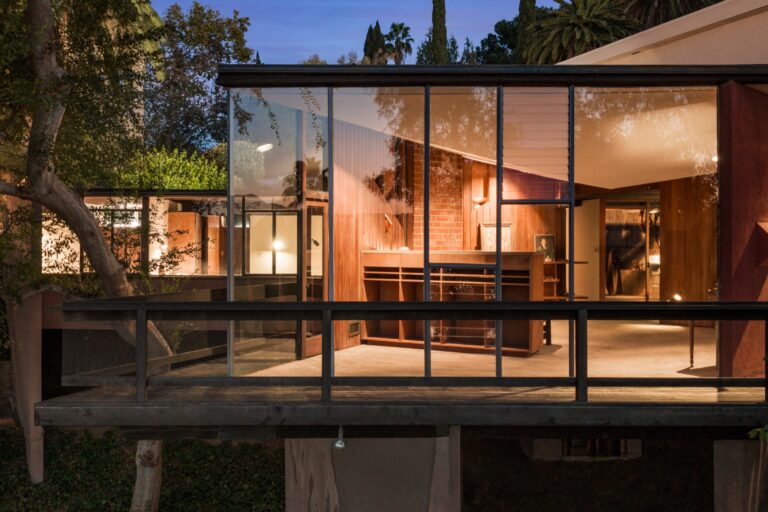
The everyday fabric is interwar, from the decades that produced the Period Revival streets nearby: Spanish Colonial, Tudor and the odd flash of Storybook. The landmarks are more particular. On upper Waverly stands the Earle C. Anthony House of 1927, designed by Bernard Maybeck for the Packard dealer who founded KFI. Elsewhere on Waverly, J. R. Davidson designed two houses: the Sam and Jane Taylor House (1947), with an original Garrett Eckbo landscape, which became Historic-Cultural Monument No. 1216 in 2020, and the Jack G. Schapiro Residence (1950), which SurveyLA calls an excellent example of Mid-Century Modern. That makes two Davidsons on one modest hill. SurveyLA also records a 1922 American Colonial Revival house on upper Waverly.
The 1920s lamps on the Waverly Drive overcrossing above Hyperion are infrastructure that works as ornament. A government photographer documented them for the Library of Congress.

Two Stories the Hill Carries
Maybeck’s house became a convent and house of prayer for the Sisters of the Immaculate Heart of Mary, who bought it in 1972. The last sisters left around 2011. A sale to Katy Perry, approved by the Archdiocese, turned into years of litigation after two sisters sold the property separately to another buyer. Perry’s option expired in 2019, and she never bought the house.
The hill has an older, darker association. In August 1969, Leno and Rosemary LaBianca were killed in their home on upper Waverly by members of the Manson family. The house number has since changed, and the street has gone on being a quiet residential street.
Ten Minutes Down the Hill
The walking figures run from St George and Waverly. The hill works in both directions: the walk down is easy, and the walk home is uphill.
Trader Joe’s and Gelson’s sit across Hyperion from each other, about a nine-minute walk away. Gelson’s stays open until midnight. On Rowena, Marta, a gallery with a courtyard it calls “a convivial, café-like gathering space,” is about eight minutes off. Blair’s does dinner. Makisupa Coffee Bar hosts the Silver Lake Track Club’s Sunday run at 7 a.m., and Broome Street General Store does coffee and provisions. Edendale is there for a drink, and Rowena Projects shows art. Mixto and Thai on Hyperion handle weeknights. For exercise there’s Rodeo Athletic Club on Hyperion and Natural Pilates on Rowena.
The Philosophical Research Society, founded by Manly P. Hall in 1934, is about ten minutes away on Los Feliz Boulevard. Its auditorium hosts film nights, which suits a neighborhood that prefers its culture slightly off the main road. Griffith Park’s southeast entrance, at the Mulholland Memorial Fountain, is about fifteen minutes on foot.


In about twenty minutes you can walk to Hillhurst for dinner at Little Dom’s, or over the Hyperion bridge to Glendale Boulevard in Atwater Village. There you’ll find Proof Bakery, Bon Vivant, Dune, the UPS Store, the branch library and the post office. Bigger errands mean a short drive: the Speedway Express on San Fernando Road, and in Glendale the Galleria and its Target, the Americana at Brand, Erewhon on Glendale Avenue and Home Depot.

The School on Herkimer
For many families, the draw sits just south of Rowena. Ivanhoe Elementary has held classes on the same Herkimer Street site since 1889, when it opened in a two-story farmhouse, and it keeps the name the area carried before Silver Lake existed. At its centennial the Times counted it among eight Los Angeles schools dating to 1889 or earlier. The main building is a 1941 Colonial Revival design by the district architect Alfred S. Nibecker Jr. A new two-story classroom building at Rowena and Auburn was scheduled for completion in 2026. The state named Ivanhoe a California Distinguished School in 2014. The district lists an Apple one-to-one program for second through fifth graders, vocal music, theater and visual art, and family involvement that extends to what the school calls “our legendary Ivanhoe Pops Band.” Attendance boundaries change, so confirm any address directly with LAUSD.
Where Three Neighborhoods Meet
Waverly Heights sits at a three-way seam. The Los Feliz institutions claim the hill, the Silver Lake Neighborhood Council’s line runs along Rowena and Hyperion, and SurveyLA places the Masonic temple on Rowena “in Atwater.” Glendale starts just past Atwater. Downtown and Burbank are each about six to seven miles away by surface streets. For Downtown, take Rowena to Glendale Boulevard or Hyperion to Sunset. For Burbank, take Los Feliz Boulevard and cut through Griffith Park to Riverside Drive.

The neighbors make useful contrasts. The Los Feliz Knolls, across Griffith Park Boulevard to the west, were subdivided in three tracts between 1922 and 1926 and form SurveyLA’s Rowena-Lowry district: 49 Spanish Colonial and Tudor Revival houses along Lowry, Rowena and Avocado, built between 1923 and 1938. The ground is gentler, the houses more uniform, and the district backs onto Los Feliz Boulevard. Franklin Hills is the closest kin, steep and threaded with stairways. Brightwell once wrote that most locals had “likely never heard it discussed in conversation or seen it on any map.” It has no supermarket at its foot, though, and Waverly Heights has two. Silver Lake is livelier, with its famous modernists clustered around the reservoir to the south. West of that reservoir, Moreno Highlands is the closer cousin, a 1920s hillside subdivision named for the silent-film star Antonio Moreno, who invested in land around his 1923 Robert Farquhar-designed estate on Micheltorena. It was modeled on Mediterranean villages, and its promoters sold it as “within twelve minutes from Seventh and Broadway.” Atwater Village is flat river floodplain with small bungalows and a proper main street. Waverly Heights is quieter than any of them and closer to the shops than most.
If you’re looking for a Westside equivalent, there isn’t a clean one, and no writer we know of has proposed one. Small hill pockets above a neighborhood shopping corner, with Griffith Park and Atwater in walking range, are an Eastside kind of place.
Jesse & David’s Take-Aways
1—A Name You Have to Know: Waverly Heights appears on no official map, but it is a coherent place: one 1887 tract, five short streets, and a reservoir that marks its edge.
2—Quiet Above, Errands Below: The hill streets are residential with no through-route. Two full supermarkets, the Rowena strip and PRS are about ten minutes away on foot, and the walk back is uphill.
3—A School With Deep Roots: Ivanhoe Elementary has taught on the same Herkimer Street site since 1889, and the state named it a California Distinguished School in 2014. LAUSD boundary data places the hill in its attendance area, but confirm any address with LAUSD directly.
4—A Three-Way Seam: Los Feliz, Silver Lake and Atwater meet here, with Glendale, Downtown and Burbank reachable without a freeway.