Suspended in Green: Ray Kappe’s Residential Manifesto
From the shaded glens of Rustic Canyon, a radical experiment in modular living quietly awaits its next custodian. Ray Kappe’s personal residence is more than a house—it is the definitive blueprint for elevated Southern Californian living.
Property Fact Sheet
The Kappe Residence Address: 715 Brooktree Rd, Los Angeles, CA 90272 Price: $11,500,000 Specs: 5 Beds | 5 Baths | 4,157 Sq. Ft. | 0.30 Acres Built: 1967 Architect: Ray Kappe, FAIA
If mid-century modernism introduced the concept of the “machine for living,” then Ray Kappe’s own home perfected the soul of that machine. Approaching 715 Brooktree Road feels less like visiting a residence and more like entering a spatial manifesto. The house does not merely sit on its hillside; it is lifted above it on six massive concrete towers, allowing the natural springs and protected topography of Rustic Canyon to remain undisturbed beneath.
Canyon sequence: Approaching the residence is an exercise in structural gymnastics. Kappe’s radical decision to lift the structure on six concrete towers—visible here as the home’s unyielding spine—allowed the site’s natural springs and lush ferns to remain untouched. The cantilevered redwood decks and deep overhangs act as a transitionary lens, framing the Sycamores and blurring the distinction between the intellectual interior and the wild Pacific Palisades canyon floor. It is a masterpiece of site-specific logic that has lost none of its avant-garde edge since 1967.
A Vertical Village
Kappe rejected the tyranny of the corridor. His home unfolds across seven split levels that intertwine like terraces in a miniature village. Movement becomes experiential: one descends from study to dining, ascends to the living platforms, and ends in the treetops. A hearth anchors the center — a sunken gathering point that recalls the intimacy of pre-modern domestic life, translated into modernist syntax.
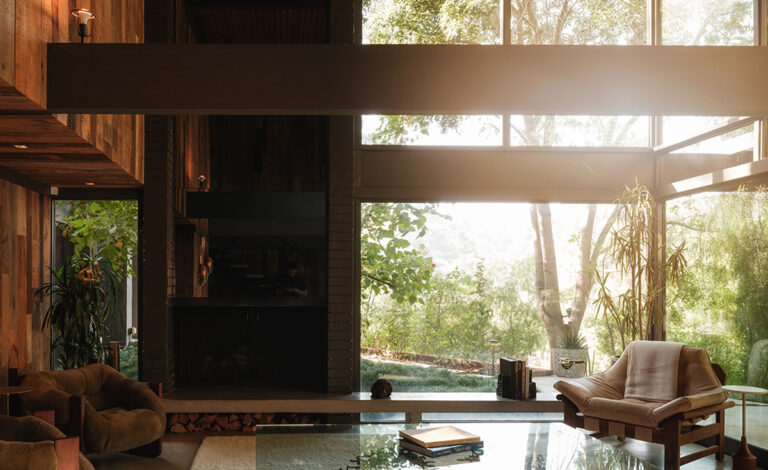
Vertical village: Kappe’s rejection of the corridor is most evident in the home’s central atrium, where seven split levels intertwine to create a dizzying sense of volume. Massive laminated timber beams overhead provide a rhythmic discipline to the space, while primary-colored accents—note the vibrant blue lounge chairs—serve as a playful nod to mid-century optimism. The open-plan design ensures that whether one is in the upper study or the lower living platform, the house functions as a singular, connected laboratory for living.Cathedral of light: The material palette of redwood and glass creates a warm, atmospheric modernism that shifts with the California sun. From this vantage point, the home’s transparency is absolute; views extend through the kitchen and dining areas into the lush canyon beyond, anchored by a central black hearth. It is a space that demands a certain level of domestic discipline, rewarding its inhabitants with a constant, unmediated connection to the shifting shadows of the surrounding trees.
A Cathedral of Timber and Light
While the canyon outside is defined by the gnarled branches of native California sycamores and coast live oaks, the interior is a masterclass in linear precision. Kappe utilized massive laminated timber beams, redwood ceilings, and expansive glass to dissolve the boundary between the living room and the canopy. The result is a “warm modernism”—intellectual yet deeply humane. It is a sophisticated treehouse for the design-literate.
The Sky-Frame: Looking upward reveals Kappe’s commitment to light as a structural element. Massive skylights are framed by redwood and concrete, turning the canopy of coast live oaks into a living ceiling. This “upward view” highlights the home’s refusal to be enclosed; even in the most protected corners of the house, the sky and the trees remain a constant, looming presence.Modular rhythm: The exterior decks and deep overhangs showcase the rhythmic precision of Kappe’s modular system. The repetitive timber beams create a play of light and shadow that changes throughout the day, while the floating rooms—appearing to hover over the canyon—demonstrate the audacity of the home’s cantilevered design. It is a structure that doesn’t just sit on the land; it participates in the environment’s own natural geometry.
Birthplace of an Institution
From the upper studio, Kappe planned the founding of the Southern California Institute of Architecture (SCI-Arc), the school that would reshape global architectural education. The home functioned as a laboratory for the ideas he would later distill into his sustainable “LivingHome” prefabs.
Our own affinity for this lineage runs deep; having represented the sale of a significant Ray Kappe LivingHome in Brentwood, we have seen firsthand how Kappe’s modular logic continues to resonate with today’s most discerning buyers. Whether it is a 1960s masterpiece or a modern prefab icon, Kappe’s DNA is a language we speak fluently.
The Professional Sanctuary: This glass-walled studio serves as the home’s intellectual engine room. Bathed in soft light from clerestory windows, the space remains a vibrant professional sanctuary and archive, populated by architectural models, personal graphics, and a lifetime of professional accolades. It remains a testament to Kappe’s enduring presence in the landscape of Southern Californian modernism.
The Modern Custodian
Today, acquiring 715 Brooktree is an act of stewardship. Its status as Historic-Cultural Monument #623 and its placement on the National Register of Historic Places secure its legacy, while the Mills Act status provides a practical financial incentive for its preservation. In an era of spec-built “luxury” that ignores the land, Kappe’s residence stands as proof that Los Angeles once built in conversation with nature—not in defiance of it.
Monolithic Warmth: In the bedroom, the central steel-clad fireplace provides a sharp, vertical contrast to the sprawling redwood ceiling. High-set skylights wash the concrete walls in natural light, proving that Kappe’s “machine” could be as serene as it was structural.Chromatic Discipline: A masterclass in color theory, this suite utilizes vibrant, primary-toned cabinetry to define space within the raw concrete and timber shell. It’s a playful, human touch that softens the home’s rigorous geometry.The Reflecting Pool: Outside, the linear pool acts as a quiet horizontal mirror to the soaring trees. Surrounded by lush ivy and native oaks, it is the final piece of Kappe’s ecological puzzle: a home that doesn’t just overlook the canyon, but coexists with its water and life.
Listed by Ian Brooks of Berkshire Hathaway HomeServices
Jesse & David’s Take-Away
1—Architectural Integrity So many mid-century works have been remodeled into oblivion. Kappe’s residence remains remarkably intact, preserving the architect’s original spatial logic and material thesis. It is the architectural equivalent of a first-edition manuscript.
2—The Kappe Expert Edge Having successfully moved Kappe’s work in the Brentwood market, we understand that these buyers are not casual; they are connoisseurs of sequence and site. This house represents the purest expression of that lineage.
3—Provenance as Value As the founding figure behind SCI-Arc, Kappe’s personal residence sits in a class of its own. Price-per-square-foot is secondary here; the primary metric is the cultural return on investment for a global landmark.
Ready to see it in person?
We would be delighted to arrange a private viewing of this exceptional property for you.