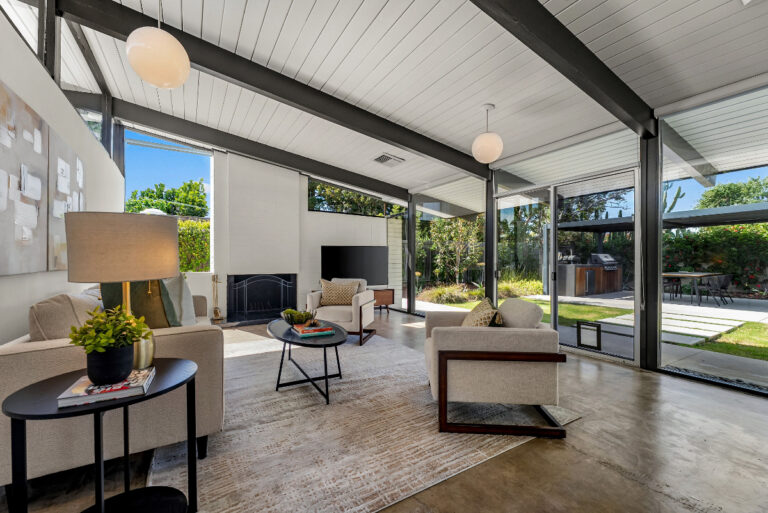
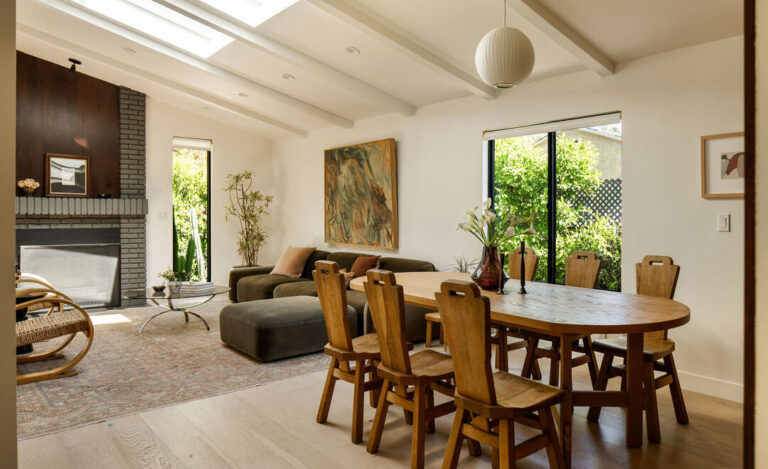
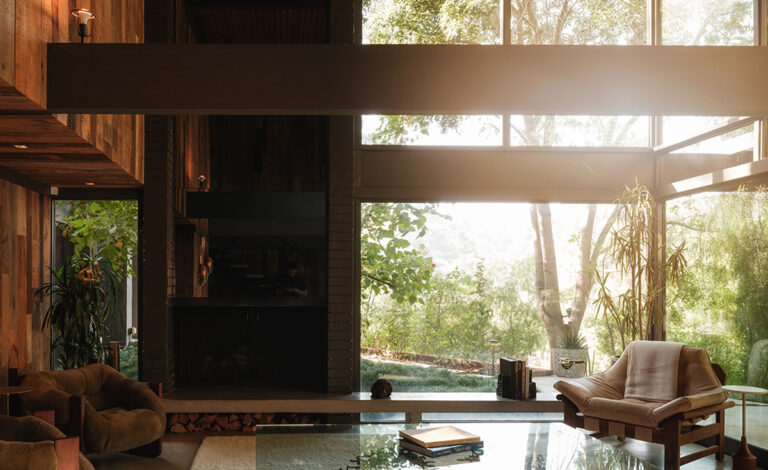
There is a particular frequency to the hills of Los Feliz, a hum that has long drawn the creative class to its winding, eucalyptus-lined streets. It is here, perched on a street-to-street double lot at 3813 Ronda Vista Place, that a distinct dialogue between two disciplines—architecture and graphic art—has just concluded a significant chapter. On October 15, the residence, known variously as the Payne Residence and more recently the Fairey Residence, sold for $4.4 million, closing the door on a decade of stewardship by the street-artist-turned-icon Shepard Fairey.
To understand the provenance of the home is to explore the rigorous, crystalline work of its architect, Christopher Payne. Before the “OBEY” giant pasted his motifs onto its walls, the structure was Payne’s own laboratory. Completed in 2007 by his firm, FIN Architecture, the house is a study in what might be called “geologic modernism.” Payne, a designer known for sustainable, site-specific solutions, did not merely place a box on a hill; he embedded a prism into the topography.

The Architect’s Eye
Christopher Payne’s work often operates at the intersection of the industrial and the domestic, a trait evident in the Ronda Vista commission. The home’s footprint, spanning some 4,000 square feet, is a series of fractured planes and volumes that mirror the San Gabriel Mountains in the distance.
“Payne’s design exploits the cliff-like forms presented to the down-slope garden, refracting distant vistas through high-ceilinged, crystalline spaces.”

The material palette is decidedly tactile—terrazzo floors that cool the California heat, handcrafted octagonal cherry-paneled ceilings that add warmth to the soaring 18-foot entry, and vast expanses of glass that dissolve the boundary between the interior and the “swimmer’s pool” outside. It is a house that demands engagement, much like Payne’s broader architectural practice which emphasizes “clean and clear design solutions” and a deep cognizance of hillside complexities.
The Artist’s Sanctuary
When Shepard Fairey acquired the property in 2015 (purchasing it from Jacob Goldblatt, who had bought it from Payne), the house found a resonant occupant. Fairey, whose work blurs the lines between propaganda, pop art, and social commentary, found a matching intensity in Payne’s angular architecture.

The residence became a creative compound. The detached guest house, with its own garage, served as a studio—a “hidden creative space” where the scent of spray paint and the hum of productivity replaced the typical domestic quiet. The listing described the home as a “creative statement, a world unto itself,” and it is easy to see why. The light in the sunken lounge, anchored by a sculptural stone fireplace, shifts dramatically throughout the day, turning the white walls into shifting canvases—a natural gallery for a man whose life is lived in high contrast.

A Layered Legacy
The recent sale of the property marks the end of an era for the house, but its architectural lineage remains distinct. It stands as a testament to a specific moment in Los Angeles design history: the mid-2000s embrace of “High Tech” modernism, softened by the bohemian spirit of the Eastside.
For the new owners, the property offers something rarer than mere luxury: a narrative. It is a space defined first by Christopher Payne’s structural rigor—his ability to bend steel and glass into a livable geometry—and second by the energetic residue of Shepard Fairey’s tenure. In a city of clones and spec-mansions, 3813 Ronda Vista Place remains a singular original.
3813 Ronda Vista Pl, Los Angeles, CA 90027 / Listed by Patricia Ruben and Alan Melkonyan / Photography by Jo David